






According to a December 2025 report on browser privacy, the newly released ChatGPT Atlas ranks as the least secure web client.
With the recent wave of AI browsing tools, a timely study by iGaming software provider Digitain examined 13 popular browsers across different security features.
Key highlights of the report include:
- ChatGPT Atlas failed 100% of state partitioning tests, meaning it cannot prevent websites from tracking users across different browsing sessions.
- Chrome ranks among the worst for privacy despite its popularity, scoring only 41 out of 100 for securing how it connects you to websites.
- Brave and Mullvad are the safest options, keeping your browsing activity completely private from advertisers and data collectors.
Each browser went through dozens of technical tests that checked three main things: whether websites can identify and track you across the internet (called fingerprinting and tracking), whether the browser blocks companies from collecting your data through cookies and trackers, and whether your connection stays secure when you move between websites.
Browsers got scored in each category, and those scores were combined into a final Privacy Risk Score from 1 to 99. The higher your score, the worse your browser is at protecting you, with 99 meaning almost no privacy protection at all.
Paruyr Harutyunyan, Group Head, Digital Marketing, Digitain, commented: “New AI-powered browsers like ChatGPT Atlas and Comet from Perplexity are getting a lot of attention right now, and millions of people are trying them out because of the AI hype.”
Just because something uses AI doesn’t automatically make it safe or private. In fact, it may even be worse for privacy protection.
He warned: “These browsers come with interesting features that traditional ones don’t have, but users need to stop and check how secure they actually are. AI works by collecting and learning from data, which means these tools might be gathering more of your personal information than you realize.”
Here’s a quick look at the 10 browsers with the highest privacy risks:
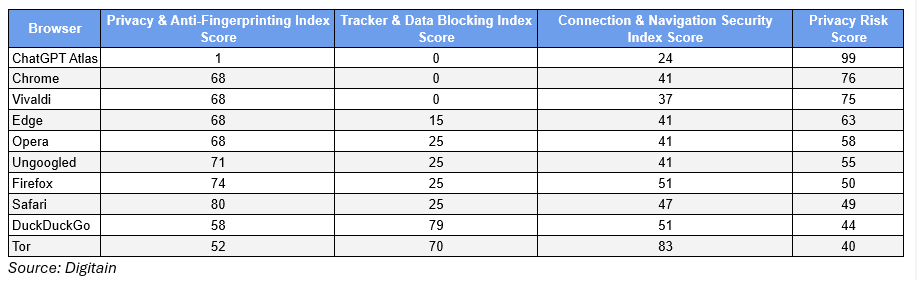
What follow are the details of the 5 least private browsers:
1. ChatGPT Atlas
- Privacy & Anti-Fingerprinting Index Score: 1 out of 100
- Tracker & Data Blocking Index Score: 0 out of 100
- Connection & Navigation Security Index Score: 24 out of 100
- Privacy Risk Score: 99
ChatGPT Atlas is the least private browser of all. OpenAI’s newly launched tool failed nearly every privacy test conducted in the study, scoring just 1 point in anti-fingerprinting protection and 0 in tracker blocking.
The browser provides no defense against websites collecting user data through cookies, query parameters, or content trackers. ChatGPT Atlas also performed poorly in basic security measures, managing only 24 points out of 100 for connection and navigation security.
2. Chrome
Chrome comes second with a privacy risk score of 76, despite being the world’s most popular browser. Google’s browser scored 68 in stopping websites from identifying you but received 0 points for blocking trackers, meaning companies can freely follow your activity across the web.
Chrome doesn’t block tracking cookies or the hidden markers that websites use to monitor where you go online. The browser earned 41 points for connection security, falling well below privacy-focused alternatives.
3. Vivaldi
Vivaldi ranks third among the least private web clients. The browser matched Chrome’s 68-point anti-fingerprinting score but similarly failed to block any trackers, recording 0 in that category. Vivaldi’s connection security also came in slightly lower at 37 points compared to Chrome’s 41.
Despite marketing itself as a privacy-conscious alternative to mainstream browsers, Vivaldi’s test results show it offers low protection against online tracking and data harvesting.
4. Edge
Next comes Microsoft Edge. The browser posted the same 68 points as Chrome and Vivaldi for anti-fingerprinting but showed slight improvement in tracker blocking with a score of 15 out of 100. Edge tied with Chrome’s connection security rating at 41 points.
While Edge performs marginally better than Chrome and Vivaldi, it still fails to provide adequate privacy protection for users concerned about data collection and online tracking.
5. Opera
Opera rounds out the five least private browsers. Like other Chromium-based browsers in this ranking, Opera scored 68 for anti-fingerprinting and 41 for connection security. However, Opera showed slightly better tracker blocking capabilities with 25 points, putting it ahead of Edge, Vivaldi, and Chrome in this category.
Despite these small improvements, Opera still ranks among browsers that offer poor overall privacy protection.