


As AI continues to redefine customer engagement and marketing operations across APAC, there’s an increasing challenge for CMOs to balance automation with authenticity.
Without a doubt, AI is fast transforming the marketing and customer experience landscape across the region and globally. But with the good, of course, comes the bad….
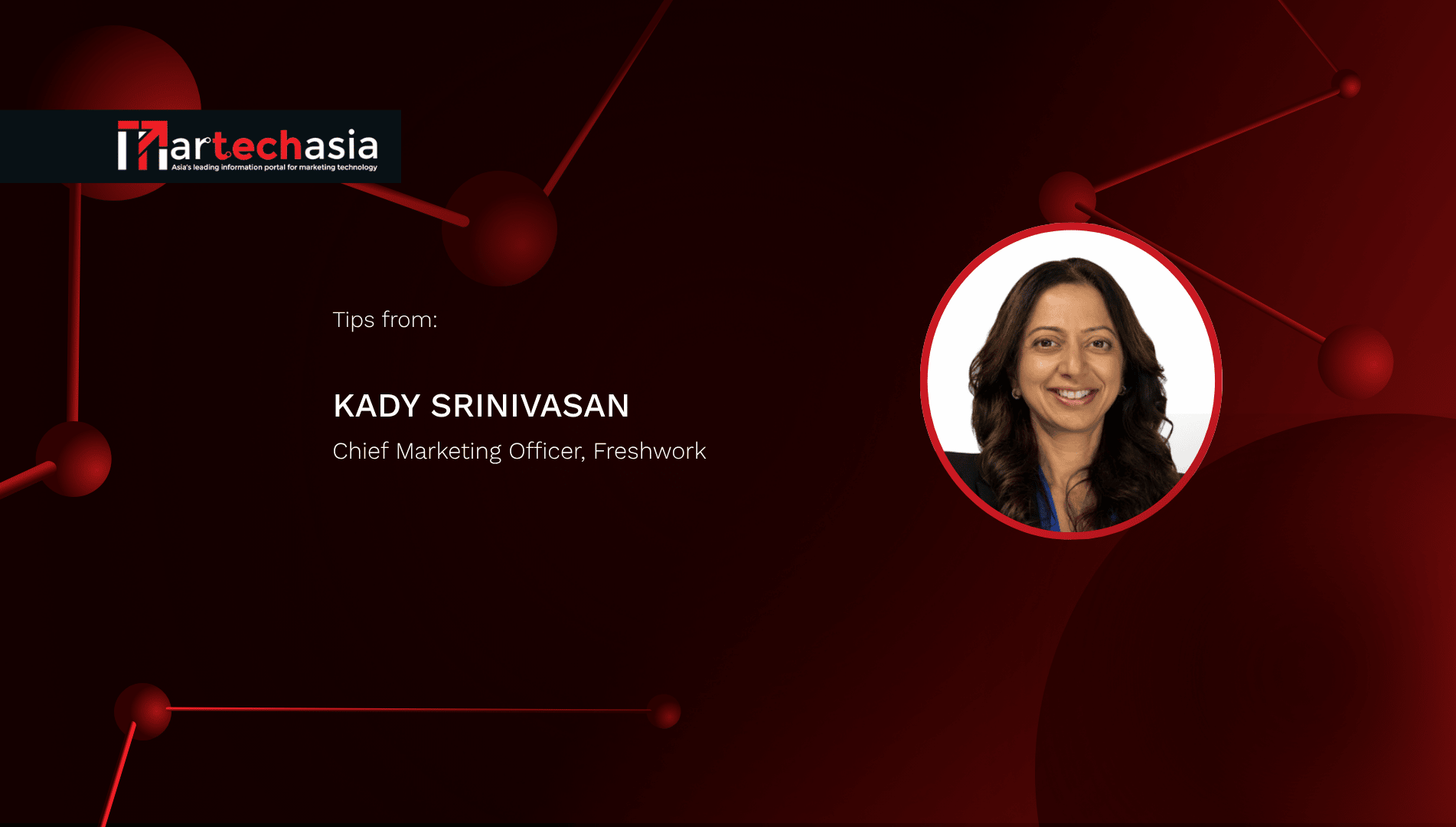
How can marketing leaders preserve creativity, empathy and brand trust in an AI-saturated landscape? Kady Srinivasan, Chief Marketing Officer, Freshworks, offered her perspectives in this Q&A.

Kady Srinivasan, Chief Marketing Officer, Freshworks.
How is generative AI reshaping marketing roles and creative workflows?
Kady: Generative artificial intelligence (genAI) is fundamentally redefining what it means to be a marketer. For years, the industry optimised for the “T-shaped” professional, someone with deep expertise in one area and broad familiarity across others. What’s emerging now is closer to an inverted “E-shape” or what I would describe as a more multi-threaded marketer, individuals who can operate across multiple domains with depth, moving fluidly between them with the support of AI.
In practical terms, this means a single marketer can now span what were traditionally four distinct roles – customer research, content creation, campaign execution, and performance analysis. AI compresses the distance between these functions, allowing individuals to move from insight to execution to optimization in a continuous loop. The result is not just efficiency, but a shift towards true outcome ownership.
We’re already seeing this take shape in how teams are structured. Roles are becoming less about function and more about accountability for business results. For example, an enterprise marketing leader today isn’t just responsible for messaging; they own the outcome of driving pipelines. That requires deep customer understanding, precise value articulation, content development, campaign orchestration, and tight alignment with sales. AI makes it feasible to operate across that entire chain with greater speed and precision.
Most importantly, this doesn’t diminish the role of humans but rather elevates it. As AI takes on an executional scale, human marketers are freed to focus on narrative, judgement, and creative direction. The future marketer is more multidisciplinary, more strategic, and ultimately more accountable for outcomes than ever before.
What have you observed about evolving customer expectations for authenticity and human connection in brand interactions?
Kady: The world’s best brands understand that resonance is essential and they succeed because they create a consistent, emotionally aligned experience at every touchpoint.
Think about walking into a great hotel. Everything from the lighting to the scent, the tone of the staff, and the design language intends to reinforce a certain feeling. In the same way, modern brands must ensure that every interaction, whether it’s a website, a sales conversation, a product interface, or customer support, communicates a coherent and human-centred story.
The challenge today is that this bar is rising quickly. Customers now expect not only seamless, modern experiences but also immediacy and personalisation. A clunky interaction or a generic message stands out more than ever. What once was considered acceptable friction is now an unacceptable liability.
Personalisation, in particular, is evolving rapidly. And it doesn’t just end there because customers increasingly expect brands to know their history, anticipate their needs, and respond in context.
The challenge for organisations is delivering this level of personalisation at scale without losing authenticity. When you’re serving tens of thousands of customers, it’s easy to default to broad generalisations. But true connection comes from making individuals feel seen, valued, and understood.
Ultimately, a brand is not what a company says it is but what its customers experience and share. And that stems from authenticity and human connection built through consistency, empathy, and a genuine commitment to customer satisfaction at every stage of the journey.
Please share some practical ways CMOs can integrate AI without diluting brand identity or empathy.
Kady: Many organisations fall into the trap of scaling output without establishing feedback loops, and the result is a model that does not seem to learn. To avoid this, chief marketing officers (CMOs) must ensure that every AI-driven initiative is measurable, monitored, and continuously optimised. This becomes even more critical as teams evolve into more multithreaded operators, where individuals are working across multiple touchpoints and decisions simultaneously, which I segment into the crawl, walk, run phases, respectively.
In the crawl phase, teams focus on augmenting individual productivity. This includes using large language models (LLMs) for drafting content, summarising insights, or accelerating workflows. The key here is context because AI is only as effective as the inputs it receives. Without clear brand guidelines, value propositions, and customer understanding, output quality will be inconsistent.
The walk phase introduces AI agents as extensions of the team. These agents are adept at handling tasks like competitive research, data analysis, or campaign support at a scale and speed that would be difficult for humans alone. However, the issue is governance and human oversight is essential for setting direction, validating outputs, and ensuring accuracy. This is why I am an advocate for the “human-in-the-loop” model as a means of safeguarding quality standards and ensuring strategic alignment.
The run phase is where organisations begin building an integrated AI layer; a centralised “brain”, if you will, that brings together brand context, customer data, strategic priorities, and performance insights. This enables teams to make smarter decisions, identify blind spots, and continuously refine their approach.
You will notice that across all three phases, governance is the defining factor. With clear frameworks for tone, messaging, quality control, and performance measurement, the oft-cited pitfalls of AI, such as fragmentation and brand dilution, are reined in.
How do you see marketing roles and strategies evolving through 2026 and beyond?
Kady: The ability to craft compelling narratives, exercise judgement, and build trust will remain foundational, there is little doubt about that even with the changes we are seeing. After all, buyers are people; they attend events, evaluate websites, and respond to stories. However, two major shifts are underway.
First, with AI increasingly embedded in every aspect of go-to-market strategy, teams will need to understand systems, data structures, and even elements of coding. This will force a reckoning for marketers. They will have to grapple with the fact that content must be equally effective at persuading humans as it is at being discoverable and interpretable by AI systems. This will be crucial to gaining competitive advantage.
Second is the rise of agent-to-agent interaction. AI agents are increasingly participating in the buying process. Marketing to these agents requires an entirely different playbook. It’s less about storytelling and more about structured data, transparent performance, and verifiable outcomes.
In this world, marketers won’t just describe value but will need to enable it to be tested and validated in real time. Documentation, APIs, and machine-readable content will become as important as campaigns and creative.
The future of marketing, then, is dual: simultaneously engaging humans with empathy and narrative, whilst equipping AI agents with the data and access they need to independently assess value. The most successful organisations will be those that can seamlessly operate across both dimensions.